
Concrete Driveway Maintenance in Schertz TX: Annual Guide
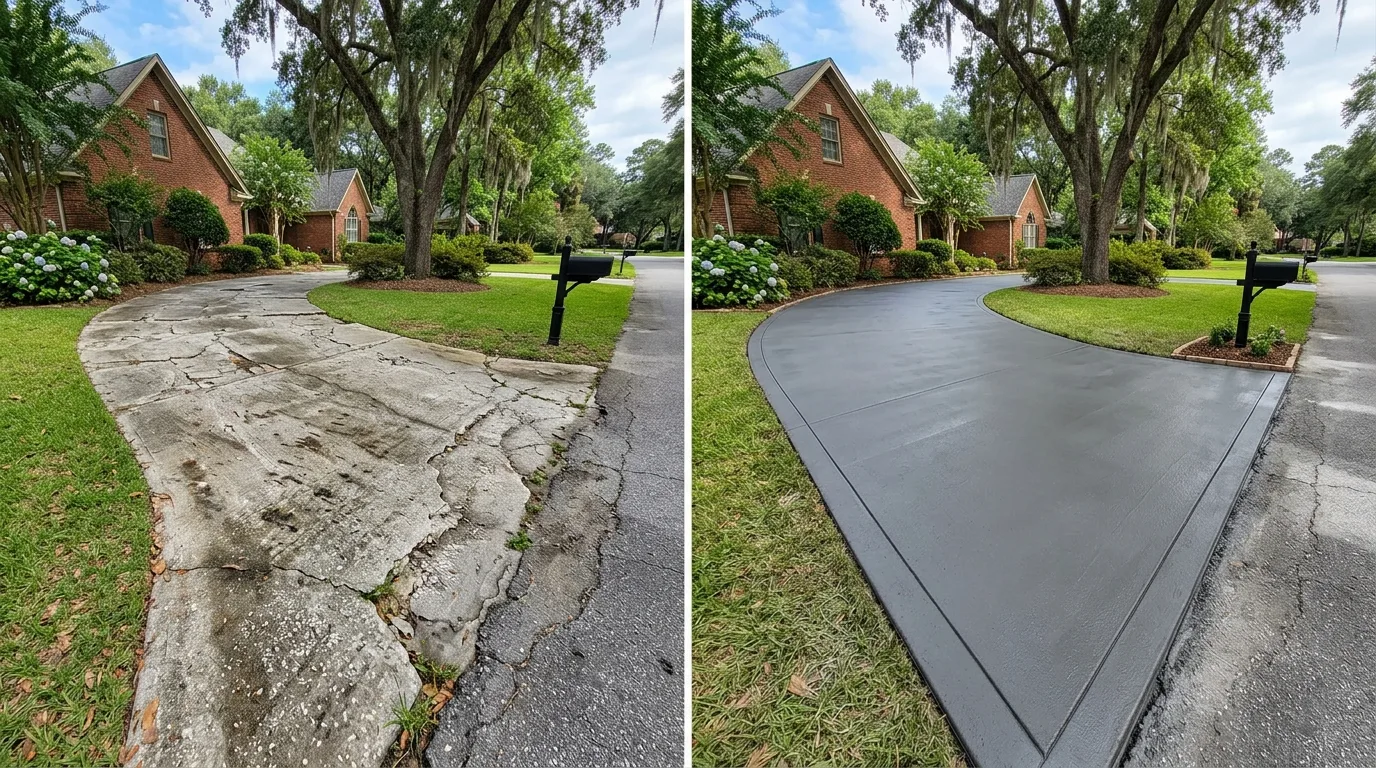
A concrete driveway in Schertz costs $4,200–$9,000 to install — a significant investment that should last 25–40 years with reasonable care. Yet many Guadalupe County homeowners watch their driveways deteriorate in 10–15 years from preventable causes: skipped sealing, ignored hairline cracks that grow into structural failures, and drainage problems that steadily undermine the clay soil subbase. The annual maintenance routine that prevents these failures costs a few hundred dollars and a few hours per year.
In this post, we cover the Schertz-specific maintenance calendar for concrete driveways, the most important maintenance task (sealing), how to identify and address cracks before they grow, and what drainage management means for Guadalupe County clay soil conditions.
Concrete Driveway Issues in Schertz? We Can Help
From sealing advice to crack repair to full assessment — call Schertz Concrete at (888) 376-0955 for a free evaluation.
Why Maintenance Matters More in Schertz Than Other Markets
Concrete driveway maintenance in Schertz operates against two persistent threats that aren’t as significant in other markets:
Guadalupe County clay soil movement: The expansive clays under Schertz’s driveways in neighborhoods like Rhine Valley and Kensington Ranch expand and contract with seasonal moisture changes, creating ongoing pressure on the slab from below. A sealed driveway with no open cracks prevents water from infiltrating the slab and further saturating the clay subbase — reducing the amplitude of this seasonal movement.
Texas UV and heat cycling: With Schertz averaging a high of 97°F in August, concrete is subjected to extreme thermal cycles — expanding in summer heat and contracting in winter. Concrete sealers that prevent moisture penetration also prevent the freeze-thaw damage that, while less frequent in Central Texas than in northern markets, still occurs during January cold snaps when temperatures drop below 32°F.
Regular maintenance interrupts both damage mechanisms before they compound.
The Schertz Concrete Driveway Maintenance Calendar
Spring (March–May): Clean and Assess
After the wet season, spring is the time to inspect your driveway carefully. The moisture from winter and spring rains will have loaded the clay subbase, potentially revealing new movement through hairline cracks at control joints or slab edges.
Walk the driveway and look for: new cracks (including hairline cracks at control joints that were previously intact), sections that feel hollow when you knock on them (indicating voids in the clay subbase beneath), sections that have shifted slightly relative to adjacent sections, and pooling water locations that indicate drainage problems.
Summer (June–August): Limit Damage
Summer heat is hard on concrete sealers. Avoid pressure washing with extremely high pressure during peak summer months — high-pressure washing removes sealers and ages the concrete surface. Keep the surface clear of standing water that heats dramatically and accelerates sealer breakdown.
Fall (September–November): Seal and Repair
Fall is the optimal season for concrete maintenance work in Schertz. Temperatures in the 65–80°F range allow sealer to cure properly and repair mortars to achieve full bond strength. If any of the following apply, schedule fall maintenance:
- Sealer hasn’t been applied in 3+ years
- Water no longer beads on the surface when sprinkled
- Hairline cracks were identified in the spring inspection
- Any control joint has cracked through and is open to water infiltration
Winter (December–February): Monitor and Protect
Schertz winters are generally mild, but cold snaps below 32°F can affect fresh concrete repairs and sealers. Avoid applying sealer or repair materials within 48 hours of a forecast freeze. During cold snaps, avoid deicing chemicals — chloride-based salts accelerate concrete surface scaling. Sand or cat litter provides traction without chemical damage.
Sealing: The Most Important Maintenance Task
Concrete driveway sealing in Schertz should happen every 3–5 years for plain broom-finish concrete and every 2–3 years for stamped or decorative concrete. The indicator that sealing is needed is simple: pour a small amount of water on the surface. If it beads, the sealer is still working. If it absorbs within seconds, sealing is overdue.
Types of sealers for Schertz driveways:
Penetrating sealers (silane-siloxane) absorb into the concrete surface and provide moisture protection without changing the surface appearance or texture. They last 5–7 years and are the best maintenance sealer for plain broom-finish driveways in Schertz.
Acrylic sealers sit on top of the concrete surface, provide a light sheen, and enhance color. They’re appropriate for stamped concrete and exposed aggregate. They last 2–3 years in Texas’s UV climate.
Polyurethane sealers provide the most durable surface film and the longest maintenance interval (3–5 years), but cost more to apply. They’re appropriate for high-use surfaces.
Fall application: Apply sealer in the fall when temperatures are consistently between 50–80°F and no rain is forecast for 24–48 hours. Clean the surface thoroughly before applying — a clean, dry surface is required for proper sealer adhesion.
How to Handle Cracks Before They Grow
Crack Filling Now Prevents Replacement Later
Schertz Concrete provides free assessment of concrete crack severity — call (888) 376-0955 before small cracks become major repairs.
Not all cracks in a Schertz driveway require professional repair. Control joint cracking — cracks that form exactly along the tooled or saw-cut control joint lines — is expected and can often be addressed with DIY backer rod and polyurethane sealant for narrow cracks (under 1/4”).
Cracks that warrant professional attention:
- Any crack wider than 1/4 inch
- Cracks that cross control joints (random cracking, not joint cracking)
- Cracks with vertical displacement — where one side is higher than the other
- Cracks in sections that also feel hollow when knocked
- Any crack near the foundation or at the junction of the driveway and house slab
For professional repair, see our concrete repair services for Schertz. The cost of filling cracks in Guadalupe County’s clay soil conditions pays dividends — once water infiltrates a crack and reaches the clay subbase, seasonal moisture cycling accelerates slab movement and crack growth rapidly.
Drainage: The Maintenance Factor Most Homeowners Miss
Drainage is the underlying maintenance issue for concrete driveways on Guadalupe County clay soils. A driveway that slopes toward the house foundation directs water into the clay subbase adjacent to the structure, accelerating the seasonal moisture cycling that drives clay soil movement and concrete cracking.
Check drainage after significant rains: Does water run toward or away from the house? Does water pool in any section of the driveway rather than draining off? Is there erosion at the edges of the driveway where water is running off the slab onto the soil?
If drainage issues are identified, correcting them may require regrading of the adjacent soil, adding drainage channels or catch basins, or in severe cases, replacing sections of the driveway with corrected grade. Addressing drainage before it causes subbase saturation is far less expensive than addressing foundation damage after years of improper drainage.
Practical Uses for Schertz Homeowners
For homeowners with concrete installed 10+ years ago: Conduct a full assessment this fall. Look for sealer condition, crack locations and widths, drainage direction, and any sections that have shifted. This assessment determines whether maintenance can extend the driveway’s life or whether replacement is becoming the more cost-effective path.
For homeowners in Riata or Belmont Park with newer concrete: Establish a maintenance schedule from the start. Seal at year 2, then every 3 years. Fill any control joint cracks in the first assessment before they have time to grow. This proactive approach is what separates 30-year driveways from 15-year driveways on Schertz clay soils.
Frequently Asked Questions
How often should I seal my concrete driveway in Schertz?
Plain broom-finish concrete: every 3–5 years. Stamped or decorative concrete: every 2–3 years due to Texas UV intensity that degrades surface sealers faster than in northern climates. The practical test is water bead behavior — if water absorbs rather than beading, sealing is needed regardless of the calendar.
Can I seal my own Schertz driveway or should I hire a contractor?
DIY sealing is appropriate for plain concrete with a penetrating silane-siloxane sealer — these are forgiving to apply and perform well. Stamped concrete resealing requires proper cleaning, degreasing, and an acrylic or polyurethane sealer applied in thin coats; a professional application is worth the cost for decorative surfaces where application errors are visible.
When should I repair a crack vs. replace the driveway slab in Schertz?
Repair is appropriate for isolated cracks in a slab that is otherwise in good condition — no widespread cracking, no settlement, no drainage failure. Replacement makes more sense when cracks are widespread (affecting more than 30 percent of the surface), when sections have settled more than an inch, or when drainage failure has undermined the clay subbase over a large area. For a specific assessment, see our concrete repair page for Schertz.
Schertz Concrete Driveway Maintenance — Start This Fall
Call Schertz Concrete at (888) 376-0955 for a free assessment of your driveway's maintenance needs — sealing, crack repair, or drainage evaluation.
Related: