
Schertz Clay Soil: What It Means for Your Concrete Patio
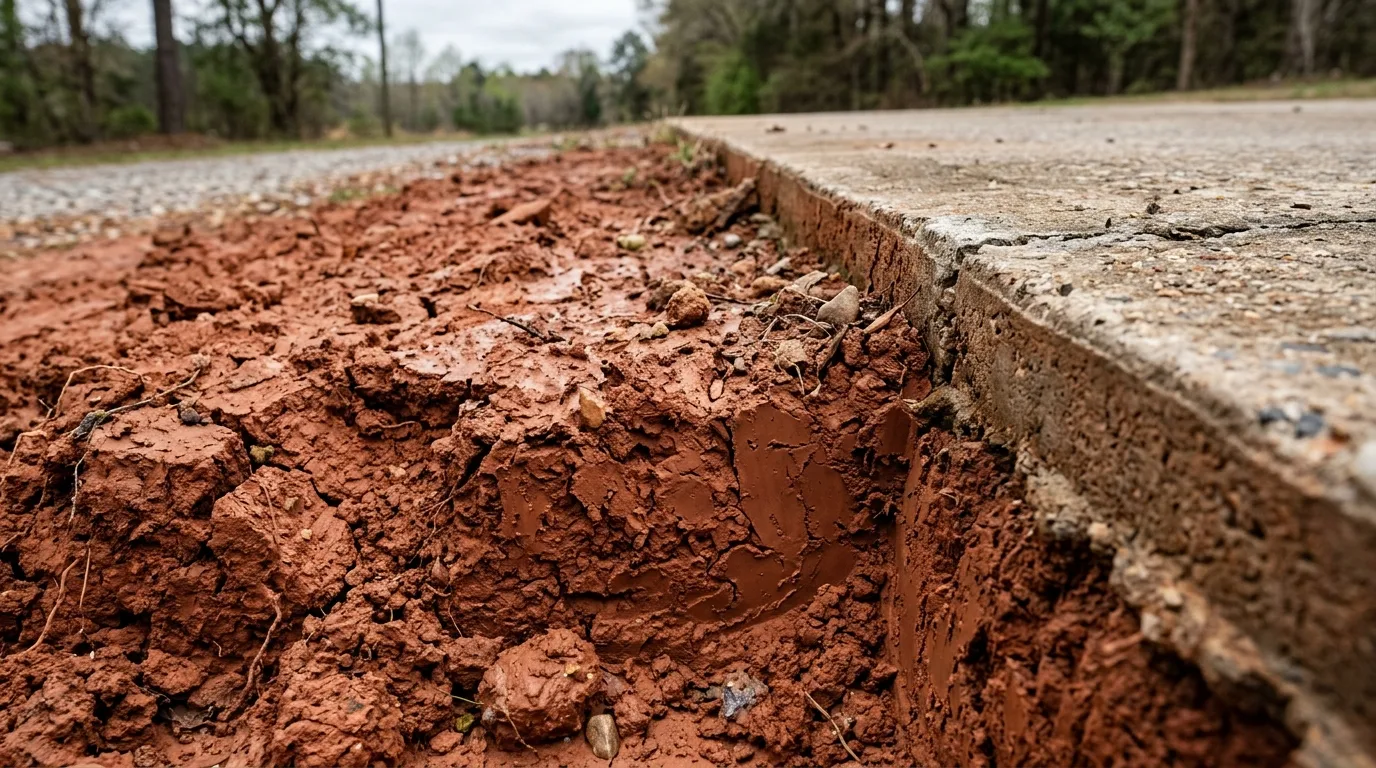
Most Schertz homeowners planning a concrete patio in Schertz know the soil is different — the clay cracks in dry summers and turns slick after heavy rain. What fewer homeowners know is exactly how that clay soil behavior drives concrete patio failure, and what a contractor needs to do differently here than in markets with sandier, more stable subgrades. Understanding the soil-concrete relationship specific to Guadalupe County tells you what to look for when evaluating bids and what questions to ask before work begins.
In this post, we cover the specific soil types in Schertz, how seasonal moisture changes cause concrete movement, what proper subgrade preparation looks like on clay, and how to spot a contractor who is skipping steps that matter here.
Schertz Patio Built for Clay Soil Conditions
We evaluate subgrade conditions before recommending base prep depth — and we explain exactly what we're doing and why.
Why Clay Soil Causes Concrete Patio Damage in Schertz
Guadalupe County sits at the transition zone between the Blackland Prairie and the Edwards Plateau — a region where expansive montmorillonite and illite clay soils dominate the shallow subsurface. These clays have a well-documented property: they absorb water and expand, sometimes by 10 percent or more in volume, then shrink and contract as they dry. For a concrete patio, this means the soil beneath the slab is never at rest. It pushes up in wet spring months and pulls away in dry summer and winter periods.
Homeyou’s Schertz-specific data puts it plainly: “If not correctly done, the soil underneath could shift. When this happens, your patio concrete flooring will most likely crack.” This is not a risk unique to Schertz — it’s a documented engineering challenge throughout the Blackland Prairie region. The key phrase is “not correctly done” — the problem is preventable with proper preparation.
Types of Clay Soil Movement Under Concrete
Expansive heave: When Schertz receives significant rainfall — May averages 4.46 inches, the wettest month of the year — shallow clay soils absorb moisture and expand upward. This pressure lifts slab edges or creates differential movement between sections poured in separate phases. Heave is most common in spring after wet winters when soils are already near saturation.
Shrinkage settlement: During dry summer and winter months, clay soils lose moisture and contract. This pulls away from the underside of the slab, creating voids. With no support beneath it, the slab flexes under foot traffic and loading, developing cracks along control joints and at unsupported midpoints. Schertz’s December precipitation averages just 1.6 inches — a stark contrast to the spring wet season.
Differential movement: When heave and settlement don’t occur uniformly — because shade, drainage, tree roots, or irrigation create moisture variations across the lot — different sections of the same slab move at different rates. This is the cause of the visible lip that develops at patio slab edges where one section has risen while the adjacent section has settled.
What Proper Subgrade Preparation Looks Like
Not All Base Prep Is Equal in Schertz
We specify and document the base prep depth for every project — no guessing, no skipping steps that matter on clay soil.
The City of Schertz code requires a minimum 2-inch compacted aggregate base under all flatwork. On clay soil, this minimum is often insufficient for residential patios subject to ongoing wet-dry cycling. Best practice in Guadalupe County:
Excavation depth: Excavate to a depth that allows for 4–6 inches of compacted aggregate base plus the full concrete slab thickness. A 4-inch slab on a 4-inch base requires approximately 8 inches of excavation below finished grade.
Base material: Use crushed limestone base (Class A flexible base is commonly available in the San Antonio market) or other locally available compacted aggregate. This material is dimensionally stable — it does not expand or contract with moisture. It creates a buffer between the expansive native clay and the concrete slab above.
Compaction: The base must be mechanically compacted in lifts. Loose aggregate dumped and not compacted provides minimal benefit. Proper compaction produces a dense, stable platform that distributes slab loads and resists clay movement from below.
Rebar reinforcement: On clay soils in Schertz, rebar (not fiber mesh alone) provides the tensile reinforcement that bridges the voids created by clay shrinkage. Fiber mesh helps prevent surface cracking but does not provide the structural continuity needed for clay-soil applications. Rebar on 18-inch grid spacing is standard for residential patio work in this area.
Control joints: Saw-cut or tooled control joints spaced every 8–10 feet in each direction create planned weak points where concrete cracks predictably rather than randomly. On clay soil, tighter joint spacing reduces the bending moment on each slab section during clay movement, limiting crack severity.
How to Spot a Contractor Skipping Clay Soil Prep
Contractors who don’t account for Guadalupe County clay soil conditions will often provide lower bids that don’t include adequate base prep. Warning signs:
Vague base prep answers: If you ask “how deep will you excavate and what will you use for base material?” and the answer is vague, the contractor may not be planning for clay-specific conditions.
Fiber mesh as the only reinforcement: Fiber mesh is a valid supplemental reinforcement but should not replace rebar on clay soil applications. A contractor who only specifies fiber mesh may not be accounting for the structural demands of clay soil movement.
No mention of subgrade inspection: On clay soils, the subgrade condition at pour time matters. A wet spring can make a previously adequate subgrade soft and unstable. A professional contractor will check conditions before pouring rather than proceeding regardless.
Skipping permits: As outlined in our Schertz concrete permit guide, the City of Schertz requires a pre-pour inspection that catches inadequate subgrade prep before concrete covers it. Contractors who skip permits also skip this quality check.
Practical Uses: Applying Soil Knowledge to Your Project
Before getting quotes: Ask each contractor: “What will you do for subgrade prep given Schertz’s clay soils?” The answer should reference base material type, depth, and compaction — not just “we’ll prep the base.”
When evaluating bids: A bid that’s $1–$2 per square foot lower than others may be skipping base prep depth. On a 300-square-foot patio, saving $300–$600 on base prep by cutting the base depth in half could result in a cracked slab that needs full replacement within 5–7 years.
In Riata or Kensington Ranch: Newer neighborhoods with recently disturbed and backfilled soils may have additional settling risk in the first few years. Discuss this with your contractor and consider a slightly thicker slab (5 inches instead of 4) during this period.
For trees nearby: Tree roots can dramatically affect soil moisture near patios — roots draw moisture, creating localized dry zones that cause differential settlement. Keep patios at least 10–15 feet from large trees where possible, and ask your contractor about root barriers if proximity is unavoidable.
Frequently Asked Questions
Does clay soil always cause concrete patios to crack in Schertz?
Not always — properly installed patios with adequate base prep, rebar reinforcement, and control joints perform well for decades even on Guadalupe County’s expansive clays. The key is preparation, not avoidance. Patios that crack within five years are almost always the result of inadequate base prep, skipped rebar, or poor drainage rather than simply being on clay soil.
How is base prep different for concrete patios vs. driveways in Schertz?
Driveways carry heavier and more frequent loads than patios, so they typically require deeper base prep and heavier rebar. Patios may get by with 4 inches of compacted base and rebar on 18-inch centers, while driveways benefit from 4–6 inches of base and 5-inch slab thickness with rebar. Both applications require the same fundamental approach — the difference is in specification level.
Can I pour a concrete patio directly on native soil in Schertz?
Code requires a minimum 2-inch compacted base, so no — but beyond code, pouring directly on unimproved clay soil is a reliable recipe for early cracking. The combination of clay expansion during wet periods and contraction during dry periods creates slab movement that no concrete can absorb without cracking unless there’s a stable, non-expansive base layer in between.
Schertz Concrete Patio Built Right for Your Soil
Call Schertz Concrete at (888) 376-0955 for a free estimate that includes subgrade evaluation and proper clay soil prep.
Related: