
Concrete Patio vs. Pavers in Schertz: Which Is Better?
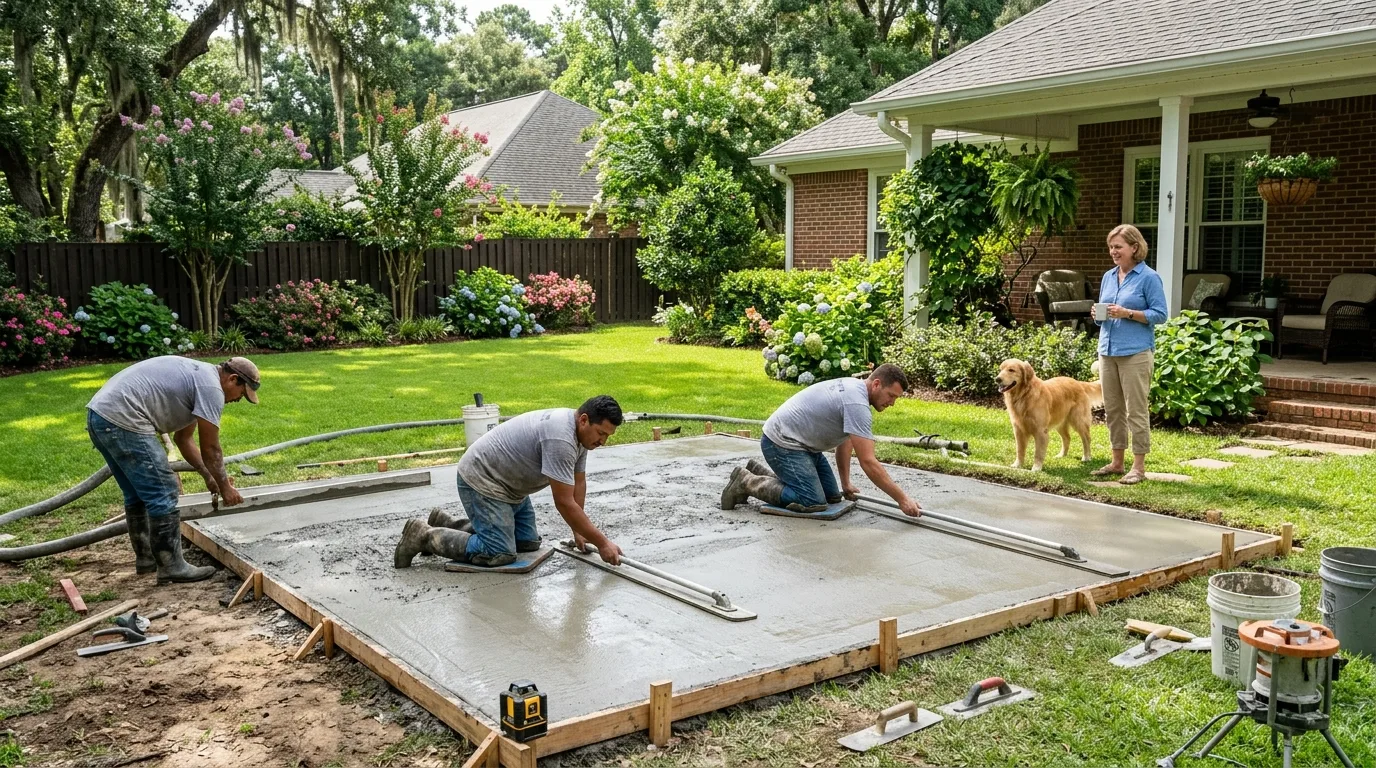
The patio debate between poured concrete and interlocking pavers comes up constantly in Schertz, TX — and for good reason. Both materials produce attractive outdoor living spaces. Both have real advantages and real drawbacks. But on Guadalupe County’s expansive clay soils and under Central Texas summer heat, the performance comparison shifts in ways that national guides don’t capture. This guide cuts through the generic comparisons to give Schertz homeowners the information they need to choose correctly for local conditions.
In this post, we cover the concrete patio vs. pavers comparison across five key factors: initial cost, durability on clay soils, maintenance, repairability, and long-term value for Schertz homeowners.
Concrete Patio Built for Schertz Conditions
Free estimates with itemized pricing for concrete slabs — and honest answers if pavers might serve you better in your specific situation.
Why the Schertz Context Changes the Comparison
Most paver vs. concrete comparisons focus on aesthetics and general maintenance. In Schertz, the specific local conditions change the calculus:
Clay soil behavior: Both concrete slabs and paver installations rest on the same expansive Guadalupe County clay. How each material handles clay-driven soil movement is one of the most important differentiators for long-term performance in this market.
Summer heat: Average August highs of 97°F affect both materials — concrete absorbs and radiates heat, which is a patio surface comfort factor. Pavers can be more comfortable underfoot in peak summer.
Drainage: Schertz averages 31.96 inches of annual precipitation, with wet springs followed by dry summers. Drainage design matters for both materials; impervious coverage rules from the City of Schertz apply to concrete slabs and may favor permeable paver installations for lots near impervious coverage limits.
Cost Comparison in Schertz
Concrete patio (installed, Schertz market):
- Basic broom-finish: $4–$8 per square foot
- Stamped/decorative: $10–$15 per square foot
- Premium multi-color stamped: $15–$21 per square foot
A 400-square-foot concrete patio costs $1,600–$3,200 for plain concrete, $4,000–$6,000 for standard stamped.
Pavers (installed, Schertz market):
- Concrete pavers (most common): $15–$25 per square foot installed
- Natural stone pavers: $25–$40+ per square foot installed
A 400-square-foot paver patio costs $6,000–$10,000 for concrete pavers, more for natural stone.
The verdict on cost: Concrete is the more affordable option, often by 30–60 percent for comparable quality. For homeowners working with a defined budget, concrete provides more surface area per dollar.
Durability on Guadalupe County Clay Soils
Schertz Clay Soils Affect Both Concrete and Pavers
We evaluate your specific soil conditions before recommending base prep depth for either material.
Concrete slabs on clay soil: A properly installed concrete slab on Guadalupe County clay — with compacted aggregate base, rebar reinforcement, and proper control joints — performs well for 25–40 years. Control joints manage cracking by creating planned weak points. The slab moves as a unit rather than as individual pieces, which maintains a level surface under uniform clay movement.
Pavers on clay soil: Interlocking pavers are often marketed as “flexible” — and they are, in that individual pieces can shift without the whole surface cracking. But on expansive Guadalupe County clay, paver flexibility becomes a liability: the soil movement that causes individual pavers to shift and heave produces an uneven surface that is a trip hazard and requires regular re-leveling. Pavers on reactive clay soils require more frequent maintenance than those on stable sandy soils.
The key factor is base preparation. Pavers installed on properly stabilized base material (minimum 4–6 inches of compacted aggregate on clay soil) perform significantly better than those installed on inadequate bases. But so does concrete. The quality of the installation matters more than the material choice when it comes to clay soil performance.
Long-term durability verdict: Both materials can perform well with proper installation. Concrete slabs are less affected by minor clay soil movement because they move as a unit. Pavers are more affected by movement in the sub-base because individual pieces shift independently.
Maintenance Requirements
Concrete patio maintenance:
- Sealing every 3–5 years (or 2–3 years for stamped concrete)
- Crack filling as cracks develop over time
- Pressure washing periodically
- Stain treatment for localized staining
Paver maintenance:
- Polymeric sand joints require re-sanding every 3–5 years as wind and rain erode the joint material
- Individual pavers that heave or sink on clay soil require re-leveling — on reactive Guadalupe County clay, this may be needed every 5–10 years in sections
- Pressure washing removes joint sand if done at high pressure — requires re-sanding afterward
- Stain resistance varies by paver material; sealing is recommended for natural stone
Maintenance verdict: Comparable maintenance effort over time. Concrete’s primary maintenance is sealing and crack filling. Pavers’ primary maintenance is joint re-sanding and re-leveling. On Schertz’s clay soils, paver re-leveling may be more frequent than in stable-soil markets.
Repairability
Concrete slab repair: Cracks are filled with matching repair material, but the patch is often visible on plain surfaces and more visible on stamped surfaces. Full slab replacement is costly. If a section of a concrete slab settles severely, mudjacking can lift it, but visible joint and crack lines remain.
Paver repair: Individual pavers can be removed and replaced, re-leveled, or repositioned without disturbing surrounding areas. If a section heaves or settles, it can be relaid on a corrected base. Color matching of individual replacement pavers can be an issue — new pavers may not match weathered ones.
Repairability verdict: Pavers win on targeted repairability. This advantage is most relevant when damage is localized and when the paver inventory matches well enough to replace individual pieces. On clay soils where movement is distributed, the re-leveling requirement is ongoing rather than one-time.
Long-Term Value in Schertz
Both concrete patios and paver patios add outdoor living value to Schertz homes. In the $300K–$500K new construction neighborhoods of The Crossvine and Rhine Valley, decorative stamped concrete or quality paver patios both command attention from buyers. For mid-range Schertz homes in Belmont Park and similar neighborhoods, concrete patios provide the better value proposition — competitive cost, proven durability, and lower total lifecycle expense.
Frequently Asked Questions
Are pavers or concrete better for Schertz’s clay soils?
Both can perform well with proper clay soil base preparation. Concrete slabs handle uniform clay movement better because they move as a unit, while pavers are more vulnerable to differential movement that heaves individual pieces. On Guadalupe County’s reactive clays, concrete slabs on a properly compacted aggregate base with rebar typically outperform pavers over 10–20 year timescales without the re-leveling maintenance pavers require.
Is a concrete patio or pavers cheaper to install in Schertz?
Concrete is significantly cheaper — $4–$15 per square foot vs. $15–$40 per square foot for pavers depending on material and finish. Over a 20-year period, the maintenance cost difference narrows somewhat, but concrete typically has the lower total lifecycle cost for most Schertz homeowners.
What if I’m near my impervious coverage limit in Schertz?
Permeable interlocking concrete pavers (PICP) may allow you to expand your patio area without counting toward impervious coverage limits, depending on how the City of Schertz classifies them for your specific project. Standard concrete slabs count fully toward coverage. Discuss this with your contractor and confirm with the city if you’re near your lot’s coverage limit.
Concrete Patio in Schertz — Right for Most Applications
Call Schertz Concrete at (888) 376-0955 for a free estimate and honest comparison of concrete and paver options for your specific project.
Related: